

BE HEARD
All Indigenous Peoples in / near Kingston and the Islands are invited to visit https://www.surveymonkey.com/r/IndigenousElectionTalkingCircle to take less than two minutes to share ideas!
At the Circle there will be an opportunity to submit questions that can be answered by candidates as well as hearing their thoughts on three pressing issues facing indigenous peoples, in Kingston and the Islands and all of Canada. The three issues that are identified as most pressing will have a question generated for all candidates to answer.

ABOUT US
Background
Across Canada there is an ongoing discussion, in regard to First Nation Peoples voting in an upcoming Federal election. Though the discussions taking place are often focused on whether First Nations Peoples should or should not vote in Federal elections as members of sovereign Nations, it has stimulated an increased interest, awareness and engagement of all forms of Indigenous communities and peoples in the electoral process.
As such, many Indigenous Peoples including First Nations, Inuit, Métis, Status and non-Status peoples are becoming more engaged than ever in the growing Canadian political movement. This includes the increasing number of Indigenous candidates who are running across the country.
Kingston and the Islands as a riding is unique in that while there is no designated First Nation within the riding many Indigenous Peoples call this home. The traditional territory of the Haudenosaunee & Anishinaabe, Kingston and the Islands is now home to more than 5,000 self-identified Indigenous Peoples; (4,225 according to the 2016 Census for Kingston alone, not including the surrounding areas which make up the riding). An increasing number of our relations are living – and self-identifying as Indigenous in the City of Kingston, the Frontenac Islands and surrounding area and are wanting to ensure that issues face them, their families and home communities are represented by a Member of Parliament who respects and honours the relationship between the Indigenous Peoples of Canada and the Government of Canada.
There has been a growing movement in our community, which has seen the development of strong community leadership, action and activity. A strong and powerful group of Grandmothers have been organizing and sharing knowledge within the community, an information network is thriving sharing ideas and opportunities and local and provincial Indigenous organizations are providing supports and services to community members including employment supports, housing, health, Elders, children and youth programming and support for students in post-secondary studies.
Invitation
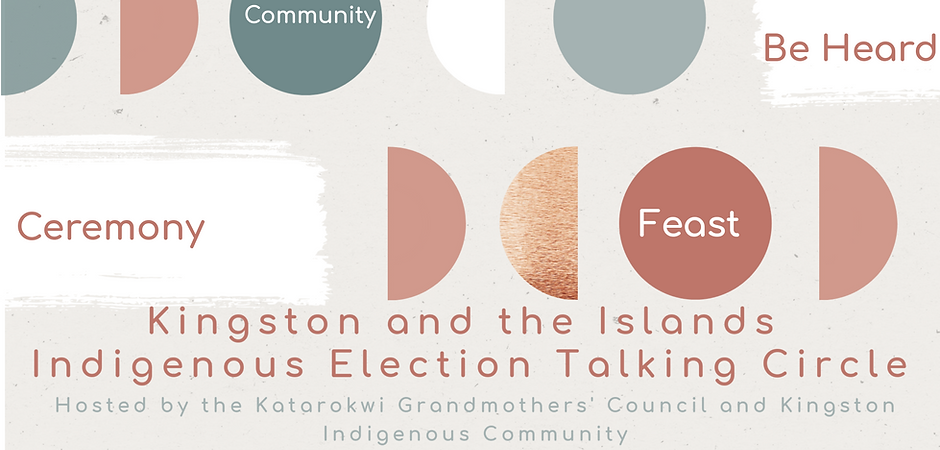
We have invited the identified candidates from each party for Kingston and the Islands to join the Indigenous community for a Community Talking Circle on September 20th, between 5:00 PM and 8:00 PM at the Kingston Community Health Centre on Weller Avenue. We have confirmed four parties will participate.
This election talking circle would be three hours in length. There would be a ½ hour meet and greet prior to the circle including following common protocol, (smudging the space and participants including candidates should they desire), seating the Elders and preparing the space.
Why A Circle?
During election campaigns often candidates meet face to face, taking questions from an audience or moderator. There are often as many references to opposing candidates in one’s answers, as an answer itself to the question. Sometimes these debates become more about putting down another’s ideas, background or experience than sharing one’s own gifts with an audience.
We are offering something different; but only different to more mainstream society and culture. Our proposed process is rooted in a history that looks to repair harm, strengthen relationships and improve communication. We received powerful feedback from candidates and participants about the positive experience and effect our 2015 Indigenous Election Talking Circle was.
Circles are widely used throughout the world to help facilitate meaningful dialogue, including within many Indigenous Peoples, here in Canada and abroad. The circle, as described in The Sacred Fire (1993) shares that ‘In traditional Native society, a sharing of ones journey is a great teacher, for it acknowledges that the pain, the laughter and love we experience can bring us closer together and helps us learn from one and others experiences.’
Our invitation to candidates applies lessons from the Seven Sacred Teachings and these are strengthened when we are working, sharing and learning in a circle. We are able to practice the laws described in the teachings: Respect, Honesty, Wisdom, Love, Bravery, Patience and Humility by each of the participants in our circle. By being in a circle it allows us to see each other, to have contact with each other directly and reminds us, that regardless of your role, lived experience or capacity – we are all equal in the circle; we will all have the space needed to define as our own. The circle promotes understanding, builds trust, helps us solve problems, reminds us that we are not alone, share in our common experiences and respect not just each other, but ourselves. We may discuss challenging topics and share traumatic episodes that generate painful moments inside a circle, which is natural. It is how we respond to this, by being together in the circle that is important. Those moments are lessened as they are not attached at that moment to feelings of isolation and shame; those attachments are removed. There are no winners and no losers in the circle. Simply a greater informed community and strengthened understanding of who the candidates are who agree to participate.
Our Process
Candidates through a random draw will be assigned a seat at either the Northern, Eastern, Southern or Western door of the Circle. This will allow for the order they will participate in. There will be two circles of chairs set out. In the inner circle there will be chairs for the candidates, facilitators and any self-identifying Indigenous participants. An outside circle of chairs will be placed behind the inner circle. These will be for any non-self-identifying Indigenous people who are interested in hearing candidates’ views, ideas and experiences regarding Indigenous Peoples as well as any supporters attending with candidates.
The role of the second circle, though a silent one (we ask that only participants in the inner circle speak), is very important. It is a reminder that our peoples (and the candidates) have allies who are in a supporting role. Though many would have relevant questions, comments or suggestions we ask that as supporters they simply listen and learn from what is shared by the inner circle. We encourage those allies in the outer circle to ask those questions they may have at other gatherings of candidates to ensure that issues facing our peoples are continually being addressed by candidates in various forums.
The Circle will be opened by a local knowledge keeper whose words will help ensure the well-being of all in attendance and our families who could not participate. These words will act to ground our circle in our traditional values and teachings (wisdom, respect, love, bravery, honesty, humility and truth).
The facilitators will then pass along the Talking Stick to each person in the inner circle. They will be invited to introduce themselves by sharing:
Name
Origin (Tribe, Clan, Nation or other)
Where in Kingston and the Islands they live
One word that would describe their ideal Member of Parliament
When a candidate’s turn comes they will be invited to introduce themselves the same way, sharing their heritage / background while also taking up two minutes to introduce themselves to the Circle.
As this occurs a pad of paper and pens will be passed along the circle. Each participant is invited to write a question for a specific candidate and/or any candidate that will then be put into a bowl. Any are welcome to pass. The bowl will be left with the facilitators.
Once the circle has completed 3 questions that were created with community input and consultation will be asked of each candidate. Each candidate will have three minutes to answer these questions based on their and /or their parties’ ideas, policies or experience. The facilitator will ensure candidates stick to the time allotted. It is important to note (see below) that we are looking for candidate’s ideas, experiences or insights. In the Circle we do not want to hear from a candidate about another candidate/party’s ability or lack of to address such an issue. We also do not want another candidate or member of either the inner or outer circle to provide commentary, talk over or interrupt in anyway as the candidate speaking.
After each of the questions have been answered there will be two questions allowed from the inner circle to candidates. Again, these questions are intended to probe deeper and not to diminish, insult or put down a candidates’ sharing. Elders will be provided the first opportunity to ask these questions and then opened up to the circle. Questions and responses will be limited to one minute each.
Upon the completion of these three community questions the circle questions will be asked. We will reach into the bowl and ask at minimum four of the submitted questions.
For each question asked we will invite two candidates to answer the questions, starting with the candidate at the Northern Door. Each candidate will have 2 minutes to speak to the question. Should there be time (more than 30 minutes) further questions from the circle will be asked, (randomly drawing the names of candidates who will answer).
The Circle will close with the talking stick being passed again with each participant answering with one sentence about how they feel about their experience in their circle. They will close with one word about how they are feeling.
Candidates again, when their turn arrives will have one minute to close and share any final thoughts.
Following the final speaker, the facilitator offers gifts and invites an Elder to close the Circle.
A thirty-minute visiting time will allow for:
One on one time between candidates and community members
Voter registration for Indigenous voters